AI-Driven Vulnerability Intelligence: The Future of Cybersecurity Research
Adversaries are now automated. Defenders still read PDF advisories by hand. BlueBook's research into vulnerability intelligence — how structured, machine-readable records beat the noise.
Yasin Saffari
Founder & CEO
Vulnerability research has a scaling problem that no amount of human attention can solve: the number of disclosed vulnerabilities grows every year, while the time a defender has to respond to any single one keeps shrinking. Between the first public disclosure of a vulnerability and its first active exploitation, there is often a window measured in days — sometimes hours. Intelligence that arrives as a PDF advisory, a spreadsheet, or a Slack message cannot be processed fast enough to matter.
This is the problem BlueFusion exists to answer. Not more data — structure. The research thesis is simple: vulnerability data becomes intelligence the moment it is machine-readable, correlated, and actionable.
The signal problem
Consider what a serious security team is actually working with. A CVE record is metadata. A proof-of-concept is evidence. A vendor advisory is an opinion. A network scan is a snapshot. An exploit's appearance in the wild is a fact with a timestamp. None of these are comparable to each other on their own — and the defender's entire job is to compare them against the asset inventory, the risk appetite, and the clock.
The current pipeline is fundamentally manual. Analysts subscribe to feeds, read advisories, copy them into ticketing systems, and correlate with their own assets by hand. It works. It does not scale.
From assessments to intelligence
BlueBook's research direction is a pipeline with four stages: collect, normalize, analyze, act.
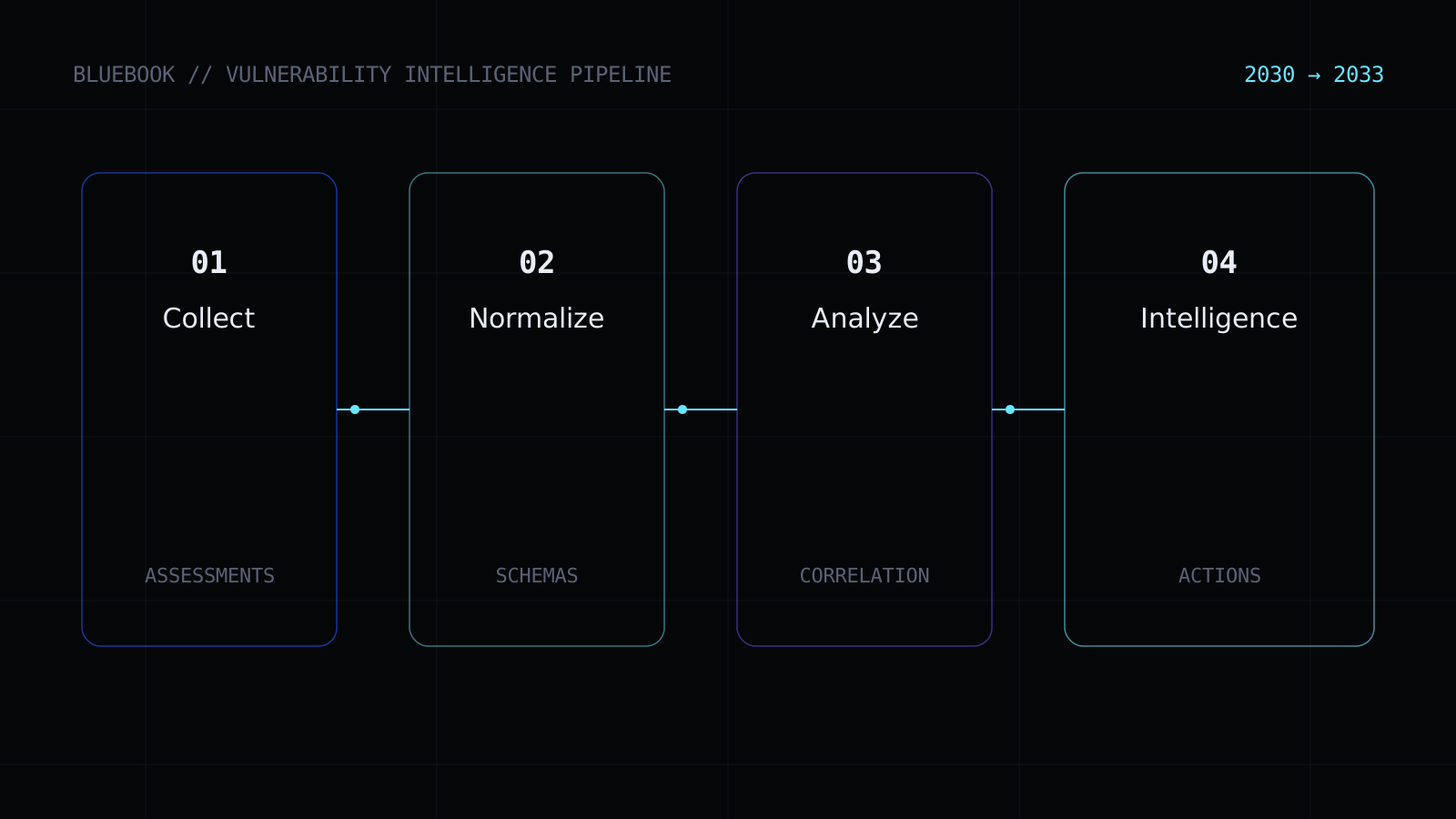
Every stage is designed to remove a specific kind of human labor. Collection removes the searching. Normalization removes the re-typing. Analysis removes the guessing. Action removes the waiting. When all four are composed, a vulnerability moves from "seen on a feed" to "scored against your assets" without a single person touching a PDF.
The structured record
The heart of the system is the normalized vulnerability record. Every source — NVD, vendor advisories, exploit databases, our own research — is reduced to the same schema. Here is what a record looks like once normalized:
{
  "cve": "CVE-2026-0417",
  "summary": "Command injection in a network management interface",
  "cvss": { "v4": 9.4, "vector": "AV:N/AC:L/AT:N/PR:N/UI:N/VC:H/VI:H/VA:H" },
  "cwe": ["CWE-78"],
  "epss": 0.97,
  "exploited_in_wild": true,
  "first_seen": "2026-07-14",
  "affected": [{ "vendor": "example-networks", "product": "mgmt-console", "versions": "<= 4.2.1" }],
  "sources": ["NVD", "vendor-advisory", "bluebook-laboratory"],
  "confidence": 0.94
}
The same shape is produced for every source. That single decision — one schema, enforced at ingest — is what turns a collection of documents into a database a machine can reason over. It is also what makes the second instrument, BlueSearch, possible: when everything shares a shape, everything can be queried with one language.
From noise to decision
Structure buys you the ability to rank. And ranking is where AI research changes the discipline — not by replacing analysts, but by compressing the space an analyst has to search. The table below compares a vulnerability assessed by severity alone against one assessed by the full intelligence record:
| Signal | Severity-only view | Intelligence view |
|---|---|---|
| Base score (CVSS) | 7.8 / High | 7.8 / High |
| Exploitation evidence | Unknown | Exploited in the wild |
| Weaponized PoC | Not considered | Public, verified |
| Business exposure | Not considered | On 14 internet-facing assets |
| Priority | Medium (ticket backlog) | Immediate |
The same vulnerability, same score — two completely different operational decisions. Severity describes how bad a vulnerability could be; intelligence describes how likely it is to be used against you. The first is a static label. The second is a recommendation with a confidence interval.
What this means for defenders
Intelligence should change what an analyst does on a Thursday, not just what a dashboard shows. Concretely:
- Triage time collapses. Records that arrive structured can be scored and routed in milliseconds, not the hours it takes a human to read and re-type an advisory.
- Prioritization becomes reproducible. Two analysts, given the same record, should reach the same decision. If they cannot, the record is incomplete — not the analysts.
- Research compounds. Every correlation the machine finds — exploit to CVE, CVE to asset class, CWE to this quarter's campaigns — becomes a permanent capability, not a memory that leaves with a person.
The road ahead
The next decade of cybersecurity research will be measured by how much of the discipline we can make legible to machines without losing rigor. The organizations that treat vulnerability data as an engineering input — structured, versioned, correlated, and verifiable — will respond to incidents in hours while their peers are still reading advisories.
Adversaries already automate. The only defensible answer is to automate the defense of the organizations we protect. That is the research BlueBook is composed around, and it is the reason vulnerability intelligence is the most important open problem in cybersecurity today.
Intelligence is not having more data than the adversary. It is having the same data, structured, the moment it matters.
— BlueBook research thesis
If this is the direction your organization wants to move, the laboratory is open to serious collaborators. We publish the methods, and we work with the organizations that carry the world's weight.
Published Jul 2026
More from the journal07Dispatch
The BlueBook Dispatch
One letter, once a month. Intelligence notes, vulnerability analysis, and the occasional silence. No noise — the record keeps track.
One dispatch per month. Unsubscribe anytime. Zero spam — it does not pass verification.